
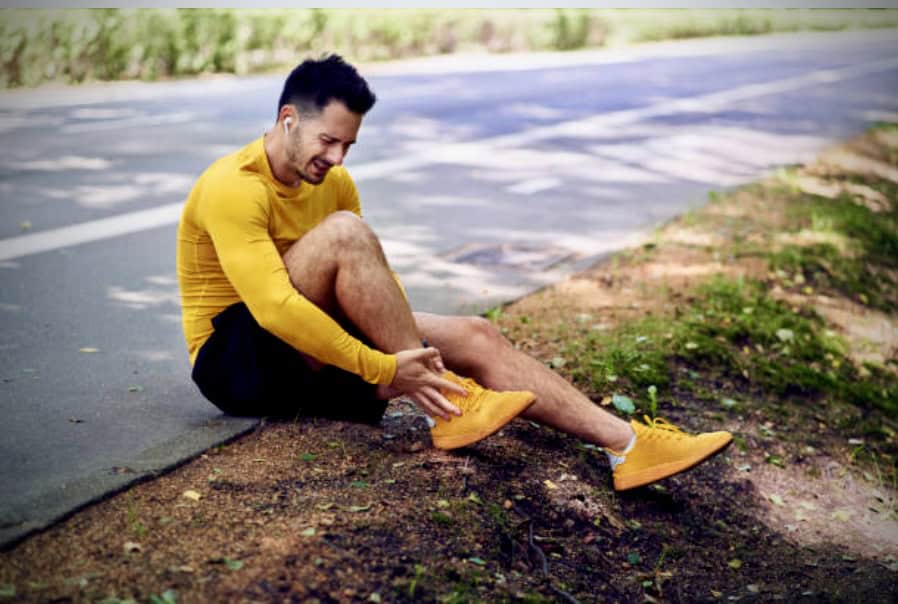
If you’re reading this, you’ve likely just recently been told that you have a plantar plate injury and it’s also quite possible that you have never heard of this before. After 5 weeks of dealing with this injury myself, I’ve pretty much done nothing but dig into solving how to heal a plantar plate injury and get back to my running routine as soon as possible.
Five weeks ago while out on a run I noticed that my 2nd toe on my left foot was feeling a little tight. Being the stubborn runner that I am, I figured it was just a cramp or was just something that would go away during the run, however a few miles into my run I suddenly thought, “Oh wow, that step hurt!”
I knew something was wrong but was not sure what. Was my toe broken? Fractured? Torn tendon? All I knew was that it hurt to stand on or to take any normal steps. Finally, I decided to do the smart thing and see a podiatrist.
It was on that day I discovered what a plantar plate injury was. Surprisingly, I was not able to find a lot of information about this injury pertaining specifically to runners. I found one anecdotal story that was helpful, but it was a few years old already.
It occured to me that I could possibly be of use and share my experience with recovering from a plantar plate sprain and my (hopeful) return to running. So let’s get into it!
What is the plantar plate?
To put it very simply, the plantar plate is basically the ball of your foot. It’s the combination of bones, ligaments, tendons, and muscles that connect the toes to the main part of the foot. In layman’s terms (please pick up on the sarcasm: “The plantar plate is a tough fibrocartilagenous structure which attaches the proximal phalanx to the metatarsal head, going through the forefoot’s joint capsule.”
A plantar plate injury is where one of these ligaments or tendons becomes overstretched, partially tears, or in more severe cases completely tears.
What are the symptoms you may be close to injury?
Looking back at the week or two before my injury occurred, I did notice some tightness, kind of like a small knot under that 2nd toe. It didn’t seem like much at the time, but if I would have been a bit more attentive, I could have taken a week off and avoided losing the 5 weeks I’ve lost so far.
What can cause a Plantar Plate injury?
Based on what I’ve been reading it could be just about anything that causes an injury like this. Things such as new or different shoes, overuse injury, or having tight muscles elsewhere that may cause you to change your running form slightly.
That is what I feel my situation was. I had been dealing with achilles tendinopathy for the past year and a half. It was mostly better but I do recall adjusting my form on certain runs to try and avoid putting so much pressure on the achilles. Eventually, I think my plantar plate just said “enough” and got my attention the only way it knew how!
Diagnosing the Plantar Plate Injury
Before you can treat the injury, it really does pay off to know what your injury is. The moment I felt the pain in my toe when I was running, I knew it was my toe, but I had no idea if it was a fracture, sprain, tear, bruise, etc. So my first step was to see a trained medical professional… not google!
A doctor will most likely have all or a combination of X-ray, MRI, or Ultrasound ordered to determine the severity of the injury. They will also perform what is called a Lachman test to determine if you have any damage to your plantar plate.
I repeat, please see a trained professional as this is your surest way to know exactly what is wrong and to begin fixing it as quickly as possible.
Treating the Plantar Plate Injury
Now that you’ve visited a doctor, and have been diagnosed with a Planter Plate injury, you’re probably here because you want to know what to do to quickly heal this thing! Here are the steps that I followed to start the healing process.
Reduce the Inflammation
First and foremost, whatever it was you were doing when you injured your toe, stop! Odds are it was from running, so as much as you hate to hear it and I hate to say it, you’ll need to stop. I’d also stop doing any forms of cross training that will put pressure on the ball of the foot such as cycling, elliptical, or arc trainer. Basically, just give it 2-3 weeks of no activity. That’s a tough ask for any serious runner, but it’ll save you so much more time in the long run. No pun intended. Stay off your feet as much as possible and keep walking and standing to a minimum for a few weeks. Rest is the initial best medicine you can apply in this situation.
Depending on how severe your injury is, your doctor may prescribe anti-inflammatory medication. I’ve read that a lot of professionals recommend not taking over the counter pills like Tylenol or Advil as those have a negative effect on the actual healing of the tendons and ligaments. As stated earlier, listen to what your doctor advises you to do.
Another way to encourage quicker healing is to do contrast baths.
Reduce the Load
You also may pick up a walking boot. It’s not always necessary, but I found that it was mostly helpful for me as an easy way to avoid answering the common question of, “Why are you walking with a limp?” It was also painful for the first few weeks for me to put on and take off my running shoe, so this saved me from that pain while the inflammation decreased. If you go with the walking boot, get one with a stiff, rocker style bottom so that you can walk without the need to bend your foot at the toes. I found this one on amazon that was relatively cheap and did the trick.
If you choose not to use a walking boot, many doctors recommend you wear a sturdy and supportive shoe such as a trail running shoe. Great brands to look into are Hoka, Asics, New Balance, and Brooks. These shoes tend to have more support and have a curved sole that allows your foot to rock so that your toes won’t bend as much. Carbon plated shoes would also be very good for this injury, however these shoes can be quite expensive and most people don’t want to spend a lot on shoes just for this purpose. A cheaper and just as effective alternative is to purchase a carbon sole off amazon and insert that into your shoe.
A budin splint was also helpful to me as it seems to help keep your toe from moving around while you walk. My doctor provided me with one, but you can also purchase these on amazon. I wore these as much as I could for the first few weeks with the walking boot. They not only hold your toe in place, but they also provided a nice padding underneath that helped with the pain.
Another way to reduce the amount of pressure on the injured toe is to tape the injured toe in place to prevent it from pulling up and aggravating the injured area. I found that using KT Tape worked really well for this and applied this technique every other day. This made wearing shoes, walking barefoot, and even sleeping at night much more comfortable.
What I found to be the most useful remedy was placing metatarsal pads underneath the insole of my shoes. Placing a pad underneath the ball of your foot reduces the pressure on the toes and the plantar plate immensely. This is a great solution for minimizing pain and ensuring that the injured area can rest.
Conclusion:
The combination of all of these strategies has worked very well for me so far. I am finally at the point where I can walk around the house without shoes on without any pain. My toe is still at a point where there is discomfort, but the pain is completely gone.
While I begin my cross training routine, I am using some insoles with the met pads placed on each one and placing them in an older pair of running shoes. I used these anytime that I’m on the elliptical, arc trainer, or indoor bike and it seems to do a great job of keeping my feet comfortable.
I will follow up with another post recapping how the full rehabilitation process went. Hopefully this information is helpful for you to figure out how long it should take until you’re ready to start your way on the comeback trail from a plantar plate sprain.